10Web Hosting Review 2026: The AI Bundle Nobody Bothered to Unbundle
Every 10Web review I've read asks the wrong question. They ask "Is 10Web worth it?" — as if it's one product. It's not. It's an AI website builder and a managed WordPress host duct-taped into a single subscription. And when you price each half separately, the math gets uncomfortable.
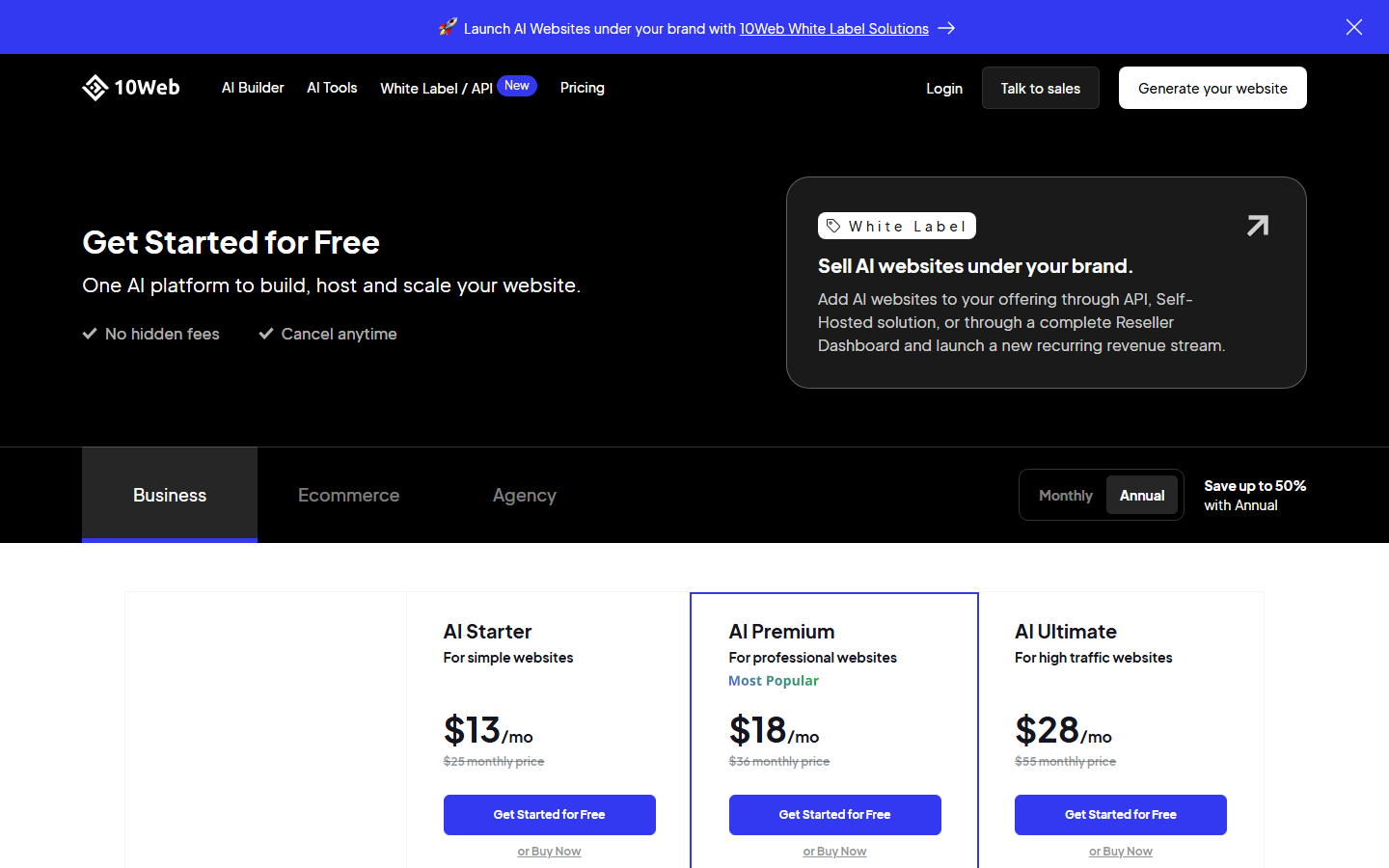
Start with the sticker price. 10Web's AI Starter plan is $10/mo — if you pay annually, $120 upfront. Choose monthly billing and that same plan costs $25/mo. A 150% markup for the privilege of not being locked in. That gap between the advertised price and the real price is the first of several transparency problems with 10Web, and it sets the tone for the unbundling that follows.
What 10Web Actually Is (And Isn't)
10Web was founded in 2017 in Newark, Delaware, with its engineering team based in Yerevan, Armenia. Co-founders Tigran Nazaryan (CEO) and Armen Saghatelian built it as an AI-first WordPress platform — the hosting was always the delivery mechanism, not the product itself.
That distinction matters. 10Web runs on Google Cloud Platform infrastructure. So does Kinsta. But the similarity ends at the cloud provider. 10Web's management layer is built around its AI builder, which is Elementor-based. You get a drag-and-drop editor enhanced with AI content generation, AI-assisted design, and automated PageSpeed optimization. The hosting underneath is managed WordPress — you don't touch the server, you don't get SSH access, you don't deploy via Git.
Here's what each Business tier includes at annual billing:
- AI Starter ($10/mo annual / $25/mo monthly): 1 site, 10GB storage, 10,000 monthly visits
- AI Premium ($15/mo annual / $36/mo monthly): 3 sites, 15GB storage, 25,000 visits
- AI Ultimate ($23/mo annual / $55/mo monthly): 10 sites, 20GB storage, 100,000 visits
The Ecommerce tiers add WooCommerce-specific features: AI Ecommerce Starter at $11/mo annual ($26/mo monthly), AI Ecommerce Premium at $23/mo annual ($56/mo monthly).
Every tier bundles the AI builder, hosting, and PageSpeed optimization together. You can't buy just the hosting. You can't buy just the builder. It's a package deal, and that's precisely the problem.
One Capterra reviewer put the builder experience bluntly: "A lot of errors between Elementor and 10WEB which makes the editor crash frequently and suffer high load." That's not a hosting complaint — it's a builder complaint. But because they're bundled, you can't swap one without losing the other.
The Unbundling Test
This is the section that doesn't exist in any other 10Web review, and it should.
10Web's value proposition is: you get an AI website builder and managed hosting in one package. The implicit claim is that bundling saves you money. So let's test that claim with actual prices.
On one side: 10Web AI Starter at $25/mo (monthly billing — the price you'd pay if you're smart enough not to commit annually to an untested platform).
On the other side: Elementor Pro Essential at $59/year ($4.92/mo effective) plus Elementor's AI add-on at $2.99/mo for 18,000 credits, plus Cloudways DigitalOcean Premium at $14/mo for managed hosting. Total: $21.91/mo.
| Stack | Builder | AI Features | Hosting | Monthly Cost | Annual Effective | Storage | Visitor Limit |
|---|---|---|---|---|---|---|---|
| 10Web AI Starter | 10Web (Elementor-based) | Included | GCP managed | $25/mo | $10/mo | 10GB | 10,000/mo |
| Elementor + Cloudways | Elementor Pro ($4.92/mo) | Elementor AI ($2.99/mo) | Cloudways DO Premium ($14/mo) | $21.91/mo | $21.91/mo | 25GB (DO 1GB) | No hard cap |
| Elementor + Kinsta | Elementor Pro ($4.92/mo) | Elementor AI ($2.99/mo) | Kinsta Starter ($35/mo) | $42.91/mo | $37.09/mo | 10GB | 25,000/mo |
| Elementor + WP Engine | Elementor Pro ($4.92/mo) | Elementor AI ($2.99/mo) | WP Engine Startup ($30/mo annual) | $37.91/mo | $37.91/mo | 10GB | 25,000/mo |
Read the Cloudways row. For $3.09 less per month, you get 2.5x the storage (25GB vs 10GB), no visitor cap, managed hosting on DigitalOcean Premium with NVMe storage, and you're using actual Elementor — not 10Web's modified version that crashes when the two platforms conflict.
The annual pricing tells a different story: 10Web at $10/mo looks like a steal compared to $21.91/mo for the separate stack. That's a $143/year gap. But to capture that savings, you have to pay $120 upfront to a company whose Trustpilot reviews are filled with billing complaints. That annual discount isn't a reward for loyalty — it's the price of lock-in.
And the Kinsta and WP Engine rows exist for context: yes, premium managed hosts cost more. But both offer 25,000 monthly visits (2.5x 10Web's cap), uptime SLAs, staging environments, Git deployment, and the kind of infrastructure management that justifies the price gap. 10Web's pricing sits in a no-man's-land: too expensive to compete with Cloudways on value, too limited to compete with Kinsta on features.
Where 10Web Actually Wins
I've spent three sections dismantling the bundle, so let me be specific about where 10Web delivers genuine value.
Single-dashboard convenience is real. If you're non-technical, managing one login for your builder, hosting, backups, and performance optimization is simpler than juggling Elementor + Cloudways + a caching plugin + an image optimizer. That's not nothing — it's the difference between a 10-minute task and a 45-minute configuration session for someone who doesn't know what a CDN is.
The AI builder does what it promises for simple sites. Landing pages, portfolio sites, basic business sites — the AI generates a workable first draft in 15-20 minutes that would take 3-4 hours to build manually in Elementor. For a freelancer who builds 5 client sites a month, that time savings has real dollar value.
Automated PageSpeed optimization works — with caveats. 10Web claims 90+ PageSpeed scores. That number needs context: a PageSpeed score measures lab conditions, not real-world loading speed. A 90 score can still mean a 3-second load time on mobile over a 4G connection. But the auto-optimization (image compression, lazy loading, CSS/JS minification) does work, and it saves you from installing and configuring 3-4 separate WordPress plugins.
One support contact for the whole stack. When your site breaks on Cloudways, you have to figure out whether it's a server issue (Cloudways support), a theme issue (Elementor support), or a plugin conflict (you're on your own). With 10Web, there's one team responsible for everything. In theory.
I wanted that to be the end of the positive section. I wanted to write "and the support is solid" and move straight to the verdict. But then I read through 200 Trustpilot reviews, and the story I wanted to tell stopped being the story the data told.
The Trust Problem: Billing, Refunds, and Support
10Web has 2,322 reviews on Trustpilot. On G2, their support scores a 9.5 out of 10. Those two data points cannot both be accurate in the way their respective platforms present them, and understanding why they diverge tells you more about 10Web than any feature comparison.
Start with Trustpilot. The billing complaints follow a pattern so consistent it reads like a template: sign up for annual plan, forget about it, get auto-renewed at full price, request a refund, get denied. One reviewer, in the all-caps of genuine frustration: "THEY RENEWED MY ACCOUNT WITHOUT ANY NOTICE AND WON'T EVEN REFUND MY MONEY NOW."
This isn't one angry customer. The renewal-without-notice pattern appears across dozens of reviews spanning 2024 through 2026. At $120 to $720 per year depending on the tier, these aren't trivial charges.
Then there's support quality. A Trustpilot reviewer described it as "glacially slow and absolutely useless" for a "completely broken" platform. Another reported raising a server performance issue only to be told the solution was upgrading: "I had a problem with high server response time, I told to the support but they just tried to upsell me the higher plan."
Now look at G2's 9.5/10 support score. How do you reconcile "glacially slow and absolutely useless" with near-perfect ratings? Two possibilities: either G2's reviewer base skews toward users with simple issues that support handles well (selection bias), or the review collection method on G2 favors satisfied customers (incentive bias). I don't know which one it is. But treating G2's score as face-value evidence of good support while ignoring Trustpilot's complaint pattern would be dishonest.
The structural issue is this: 10Web's billing practices create a trust deficit that no amount of feature bundling can offset. If you sign up annually to get the $10/mo price, you're betting $120 that you'll remember to cancel before auto-renewal, that the cancellation process works smoothly, and that if something goes wrong you'll get a fair resolution. Trustpilot suggests that bet doesn't pay off reliably.
Performance Reality Check
10Web reports TTFB (Time to First Byte) figures in the 52-90ms range, which would be excellent — competitive with premium hosts that charge 2-3x as much. But third-party benchmarks and user reports tell a less flattering story.
| Feature | 10Web AI Starter | Kinsta Starter ($35/mo) | Cloudways DO Premium ($14/mo) | WP Engine Startup ($30/mo annual) |
|---|---|---|---|---|
| Infrastructure | Google Cloud | Google Cloud | DigitalOcean Premium | Google Cloud / AWS |
| TTFB (reported) | 52-90ms (10Web claim) | ~200ms (independent benchmarks) | ~250ms (community reported) | ~200ms (independent benchmarks) |
| Uptime SLA | None published | 99.9% | None (community reports 99.95%+) | 99.95% |
| Monthly Visitors | 10,000 | 25,000 | No hard cap | 25,000 |
| Storage | 10GB | 10GB | 25GB (DO 1GB plan) | 10GB |
| Staging | Yes | Yes (premium) | Yes | Yes (3 environments) |
| SSH / CLI Access | No | Yes | Yes | Yes |
| Git Deployment | No | Yes | Yes (via plugin) | Yes |
| PHP Workers | Not disclosed | 2 (Starter) | Configurable | 2 (Startup) |
| CDN | Included | Included (Cloudflare enterprise) | Cloudflare add-on ($4.99/mo) | Included |
| Overage Cost | $2/10K extra visitors | $0.50/1K extra visits | N/A | $2/1K extra visits |
A note on those TTFB numbers: 10Web runs on Google Cloud, and so does Kinsta. But "Google Cloud" is an infrastructure provider, not a performance guarantee. The management layer — how the host configures caching, PHP workers, database optimization, and CDN routing — determines actual speed. Two restaurants can buy the same ingredients; the food still tastes different.
The reliability picture is worse than the speed picture. A Capterra reviewer documented a pattern that should concern anyone evaluating 10Web for a production site: "Their backup broke frequently, not that they discovered it but me. Sites would go down on an almost monthly basis with 5xx errors."
Monthly 5xx errors on a managed hosting platform. That's the kind of problem that 10Web's 7-day free trial is specifically too short to catch — you'd need 60-90 days of monitoring to see whether the pattern holds. And at $25/mo for monthly billing, three months of testing costs $75 before you've decided whether to commit.
Compare that to Cloudways at $14/mo with hourly billing — you can test for three months at $42 total, cancel anytime without a refund dispute, and you've spent less than one month of 10Web's AI Ultimate plan ($55/mo). Even Kinsta at $35/mo, despite being the most expensive option, has a published 99.9% uptime SLA that gives you contractual recourse if things go wrong. 10Web publishes no uptime SLA at all.
Verdict: Who Should (and Shouldn't) Buy 10Web
I started this review expecting to find a decent hosting platform buried under overhyped AI marketing. What I found instead is an AI builder platform with hosting attached as an afterthought — and neither component is best-in-class.
The math doesn't support the bundle. At monthly pricing, you pay more for 10Web ($25) than for Elementor Pro + AI + Cloudways ($21.91), and you get less storage, a visitor cap, inferior hosting reliability, and a builder that conflicts with its own Elementor foundation. At annual pricing ($10/mo), the savings are real but they come packaged with billing practices that a disturbing number of customers describe as predatory.
Non-technical solo site owner who wants one dashboard and never plans to scale: 10Web is defensible, but only on monthly billing. Start at $25/mo. Test for 90 days minimum. Check your server logs for 5xx errors. If the site stays stable, then consider annual. Never start annual.
Developer or agency wanting server access, Git deployment, or custom PHP configurations: No. 10Web doesn't offer SSH, CLI, or Git. Cloudways gives you a managed server with full root access at roughly half the price. Kinsta gives you premium managed WordPress with staging, Git, and 2.5x the visitor cap. Both are better choices.
WooCommerce store owner: No. The Ecommerce Starter ($26/mo monthly) caps you at 10GB storage and 10,000 visits. An online store with product images and moderate traffic will hit both limits within months. The $2/10K extra visitor fee and $2/5GB extra storage fee add up fast. The same Cloudways plan from the comparison above — 25GB, no visitor cap — costs half as much.
Anyone whose primary concern is hosting reliability: No. Monthly 5xx errors, no published uptime SLA, and a support team whose solution to performance problems is "upgrade your plan" — that's not a managed hosting provider you can depend on for a business site.
Where this advice breaks down: if the thought of managing separate accounts for your builder and your host genuinely overwhelms you, and your site will never outgrow 10GB storage or 10,000 monthly visits, the single-dashboard convenience has real value that my unbundling math doesn't capture. The convenience tax is only a bad deal if you'd actually use the freedom of separate tools.
10Web built something genuinely interesting: an AI-first WordPress platform. But they priced it as if the bundle justifies a premium, when in reality the bundle is the constraint. You can't use the hosting without the builder. You can't use the builder without the hosting. And when either component underperforms, you're stuck with both.
The $10/mo headline is marketing. The $25/mo reality is a convenience tax. And convenience isn't worth much when the billing department can't be trusted with your credit card.
FAQ
Is 10Web's AI builder good enough to replace hiring a developer?
For a landing page or basic business site, yes — you'll get a functional design in 15-20 minutes that would take a developer 4-6 hours. For anything with custom functionality, WooCommerce product logic, or complex layouts, no. The AI generates an Elementor-based starting point, not a finished product. Expect to manually rework 60-80% of any page more complex than a homepage. If you're building simple sites repeatedly (freelancer, small agency), the time savings is real. If you need one custom site done right, hire the developer.
Can I use 10Web hosting without the AI builder?
Technically yes — you can ignore the AI tools and just use the hosting. But you're still paying for them. The AI Starter plan at $25/mo monthly includes the builder whether you use it or not. There's no hosting-only tier. At that price, Cloudways ($14/mo) or even Kinsta Starter ($35/mo) gives you better hosting without subsidizing an AI builder you don't want.
What happens to my site if I leave 10Web?
Your WordPress content exports normally — posts, pages, media library all come out through standard WP export or a migration plugin like All-in-One WP Migration. The Elementor layer is where it gets messy. Pages built with 10Web's modified Elementor will mostly survive the move if you install Elementor Pro on the new host, but any sections using 10Web-specific widgets or AI-generated layout blocks won't transfer cleanly — expect broken sections that need manual rebuilding. The bigger pain point: 10Web's auto PageSpeed optimization (image compression, lazy loading, CSS/JS minification) is platform-specific. When you leave, those optimizations vanish and your PageSpeed scores drop until you install and configure replacements — typically WP Rocket or LiteSpeed Cache plus ShortPixel for images. Budget a full afternoon for the migration itself and another session a week later to catch the performance regressions you missed the first time.
Is 10Web's Google Cloud hosting the same quality as Kinsta's?
No. Both use Google Cloud Platform, but that's like saying two restaurants are identical because they buy from the same produce supplier. Kinsta has spent years optimizing their server stack specifically for WordPress — custom PHP workers, Cloudflare enterprise CDN integration, proprietary caching. 10Web's GCP implementation is newer, less mature, and optimized around their AI builder rather than raw hosting performance. Kinsta publishes a 99.9% uptime SLA. 10Web publishes none.
Should I buy 10Web's annual plan?
Not upfront. The annual plan ($10/mo for AI Starter, $120 billed once) saves 60% over monthly ($25/mo). That's $180/year in savings. But annual billing means you're $120 deep before you've verified hosting reliability, tested support responsiveness, or confirmed the AI builder works for your use case. Given the volume of Trustpilot complaints about auto-renewal surprises and denied refunds, the risk outweighs the savings. Start monthly. Run for 90 days. Check your server logs. If everything is stable and you're genuinely using the AI tools, switch to annual at month 4. Set a calendar reminder 30 days before renewal.
Is 10Web good for WooCommerce?
Not at scale. The Ecommerce Starter plan ($26/mo monthly) caps you at 10GB storage and 10,000 monthly visits. A modest WooCommerce store with 200 products and product photography will use 3-5GB on images alone. Hit 10,000 monthly visitors — roughly 330 per day, which qualifies as a small store — and you're paying $2 per additional 10,000 visitors. At 30,000 monthly visits you're at $26 + $4 = $30/mo, at which point Kinsta Starter ($35/mo) with 25,000 visits, a real uptime SLA, and WooCommerce-specific optimizations is $5 more for a significantly better product. Cloudways at $14/mo with no visitor cap is half the price from day one.