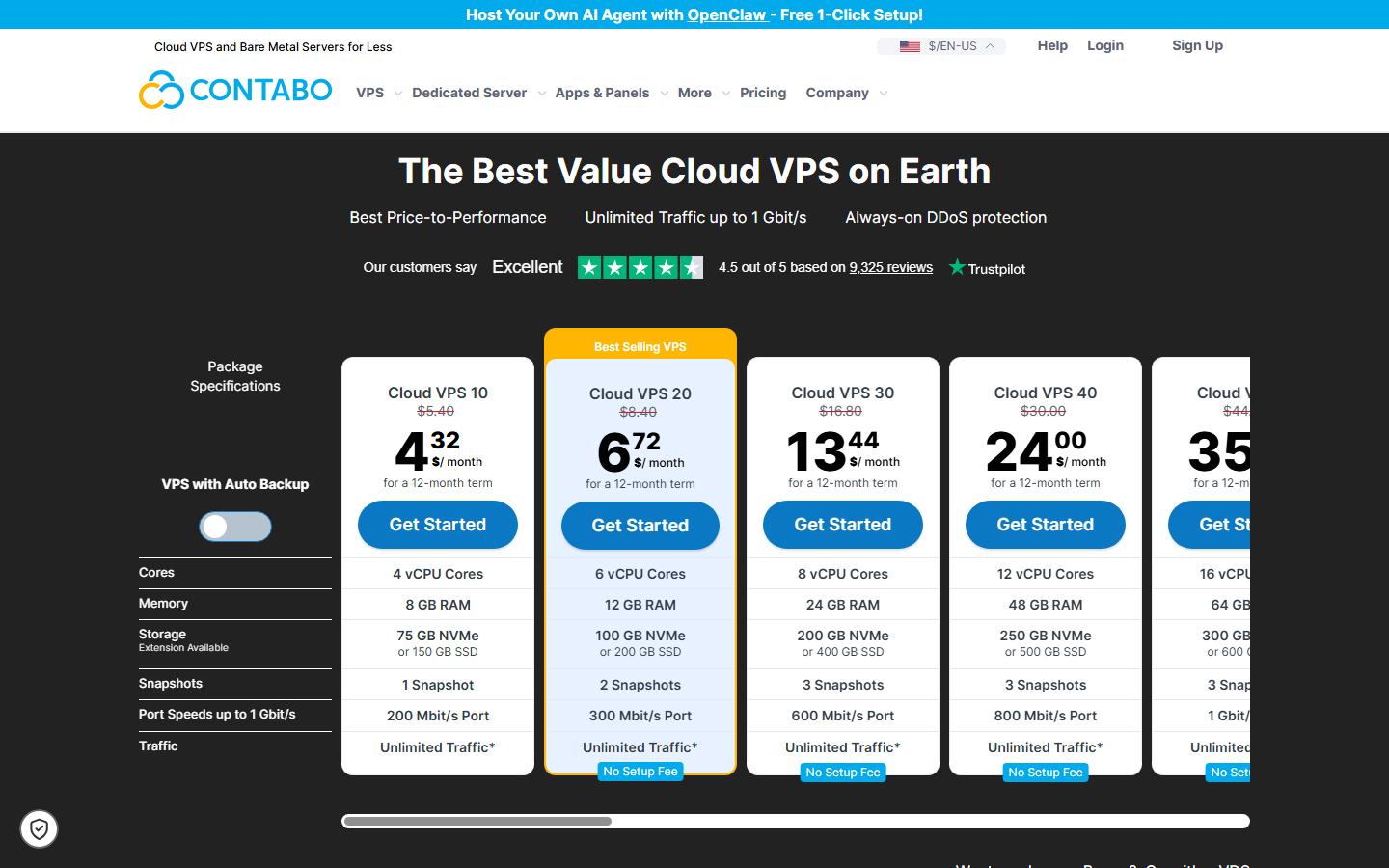
Contabo will sell you 4 vCPU, 8 GB RAM, and 75 GB NVMe for €4.50 a month. Vultr charges $6/month for 1 vCPU and 1 GB RAM. At those numbers, the rational move is to not even look at Vultr. Most people don't. The ones who've been through a Contabo production outage at 11 PM on a Friday always do.
I've used both. Contabo for a staging environment and archive storage over 14 months. Vultr for three production projects across different regions. The price gap between them is real, but the reasons for that gap determine whether you're saving money or lighting it on fire. Nobody breaks down that math, so here it is.
What Contabo Actually Sells
Contabo has been around since 2003, headquartered in Munich, running their own data centers across 12 locations in 9 regions. They've consistently offered more raw specs per dollar than almost anyone in the market. Their Cloud VPS 20—6 vCPU, 12 GB RAM, 100 GB NVMe—goes for €7.00/month on annual billing. That's roughly the price of a sandwich.
The sandwich metaphor is appropriate, because what you're getting is a time-share on hardware that's being sliced very thin.
Contabo achieves those prices through aggressive oversubscription. They pack more virtual machines onto each physical server than providers like Vultr or DigitalOcean. When the node is quiet, your 4 vCPU plan can genuinely perform like 4 cores. When your neighbors get busy—and on a heavily oversold node, they will—your 4 vCPU performs like 1. Sometimes less.
This isn't speculation. On WebHostingTalk, a user running a PHP application on a Contabo VPS reported: "On a VPS with 6 cores and 16GB memory costing less than $15/month, a PHP-based application was very slow and the server would often restart." Sub-$15/month for 6 cores and 16 GB of RAM, and the application couldn't stay running.
And upgrading doesn't reliably fix it. One HostAdvice reviewer paid for a higher tier and got worse results: "Even after upgrading to a higher-tier VPS, the new server was significantly slower, taking 15-30 seconds to load a page, and it took 5 days for support to respond." When the problem is node density, buying a bigger slice of an overcrowded server doesn't change the crowd.
Geekbench single-core scores on Contabo VPS plans swing between roughly 400 and 800 depending on what VPSBenchmarks catches on any given test. That's a 2x variance. On Vultr, the same metric stays within a much tighter band because the vCPU allocation is closer to what you actually get.
None of this makes Contabo a scam. It makes them economy class. Economy class is a legitimate product—you just need to know you're buying it.

What Vultr Actually Charges For
Vultr was founded in 2014 in New Jersey and has scaled to 32 data centers across 6 continents. Their cheapest Regular Cloud plan—1 vCPU, 1 GB RAM, 25 GB NVMe—runs $6/month. Their High Performance equivalent with newer AMD CPUs is $7/month. On paper, that's pitiful next to Contabo's specs.
But the $6 buys you something that doesn't show up on a comparison table: consistency. Vultr's vCPU allocation is closer to semi-dedicated. When you provision 1 vCPU, you get something that behaves like 1 vCPU at 2 AM and at 2 PM. That predictability is the product.
Beyond raw compute, the $6 also gets you into Vultr's ecosystem: a mature API, 32 deployment regions (Tokyo, Seoul, Singapore, Mumbai, Sao Paulo—places where Contabo simply has no presence), block storage, managed databases, Kubernetes, load balancers, and firewall rules built into the dashboard. If you're building infrastructure, not just renting a box, this matters.
Vultr's not clean, though. Their account verification process is aggressive—government ID, selfie, credit card photos. And their automated fraud detection system has a documented hair trigger. One G2 reviewer wrote: "Vultr created a major business hurdle by seizing my $100 deposit and terminating the account immediately after a successful document verification." That's not an isolated complaint. It's a pattern on Trustpilot and G2, concentrated among new accounts.
And Vultr's own support isn't great. A Trustpilot reviewer called it "One of the worst services I have ever used... support is extremely bad." The difference between Vultr support and Contabo support isn't good vs. bad. It's bad vs. worse.
The Workload Decision
Stop asking "which is better." Start asking "what am I running."
These two providers optimize for fundamentally different workloads. Contabo optimizes for specs-per-dollar. Vultr optimizes for predictable performance and global reach. The right answer depends entirely on what your server needs to do.
| Workload | Winner | Why | Key Data Point |
|---|---|---|---|
| Dev/staging environment | Contabo | Performance inconsistency doesn't matter when nobody's watching. 8 GB RAM for €4.50/mo lets you mirror production specs cheaply. | Contabo VPS 10 = €4.50/mo vs Vultr 4 GB = $24/mo |
| Storage/backup/archive | Contabo | 200 GB NVMe at €14.00/mo (VPS 30). You're paying for disk, not CPU. Oversubscribed cores are irrelevant for cold storage. | Contabo VPS 30: 200 GB NVMe at €14/mo |
| Production web app | Vultr | Page load consistency matters for real users. A 2x Geekbench variance means your P95 latency is a coin flip on Contabo. | Vultr Regular 2 vCPU/4 GB: $24/mo, stable IOPS |
| Global SaaS (multi-region) | Vultr | 32 DCs vs 9 regions. If your users are in Asia-Pacific or Latin America, Contabo doesn't have a local option. | Vultr: Tokyo, Seoul, Singapore, Mumbai, Sao Paulo |
| Game server | Vultr | Tick rate depends on consistent single-thread performance. Contabo's Geekbench 400-800 swing kills multiplayer. | Geekbench SC: Contabo ~400-800 vs Vultr tighter band |
| Email server | Neither | Both have IP reputation problems from shared pools. Use a dedicated email service. | Users report €46 reactivation fees when recycled IPs get flagged |
Three questions to decide in 30 seconds:
- Does anyone other than you depend on this server's uptime? Yes → Vultr. No → Contabo is fine.
- Is your workload CPU-bound or storage-bound? CPU → Vultr. Storage → Contabo.
- Do you need a datacenter in Asia, South America, or Africa? Yes → Vultr. Contabo doesn't go there.
If all three answers point to Contabo, you'll save real money. If even one points to Vultr, the savings on Contabo will cost you more than the price difference.
The Costs Not on the Invoice
Here's the math nobody does.
Say you're a freelance developer billing $50/hour. You deploy a production WordPress site on Contabo's VPS 10 at €4.50/month. Over 12 months, that's €54 for hosting.
Now factor in what Contabo users actually report:
- Support response on critical issues: 24-72 hours. One Reviews.io user put it bluntly: "Their support is slow, unresponsive, and completely unprepared to handle emergencies. Contabo cannot be trusted for any business-critical infrastructure." If your server goes down on a Friday, you may not hear back until Monday. One 48-hour outage where you're scrambling to migrate or waiting for a ticket = easily 3 hours of your time at $50/hour.
- IP reputation roulette. Contabo recycles IPs aggressively. Users report receiving IPs already blacklisted from previous tenants, getting their brand-new VPS suspended within hours, and being charged a reported €46 activation fee to restore service—while the clock keeps ticking on monthly billing.
- The hardware lottery. You might get a quiet node with great performance. You might get a packed node where PHP restarts are a weekly event. There's no way to know before you deploy, and no guaranteed way to fix it without canceling and re-provisioning (and hoping the next draw is better).
A conservative 12-month scenario for a production site on Contabo vs. Vultr:
| Cost Item | Contabo (VPS 10) | Vultr (Regular 2 vCPU/4 GB) |
|---|---|---|
| Monthly hosting (×12) | €4.50 × 12 = €54 | $24 × 12 = $288 |
| US East surcharge (if applicable) | €1.40 × 12 = €16.80 | Included |
| One support incident (48h downtime, ~3h your time) | $150 | $50 (faster resolution, ~1h) |
| IP blacklist cleanup (1 occurrence) | ~€46 reported fee + ~2h time = ~$146 | Free IP swap via API, 15 min |
| Performance investigation (fio testing, migration eval) | ~4h = $200 | $0 (consistent baseline) |
| 12-month realistic total | ~$580 | ~$340 |
The €4.50/month server cost around $580 over a year. The $24/month server cost $340. Contabo was cheaper on the invoice and more expensive in reality.
To be clear: this math only applies to production workloads where downtime and performance matter. If neither matters to you, these hidden costs evaporate. Which brings us to the part most comparisons skip entirely.
When Contabo Is the Right Call
Everything I've written so far makes it sound like Vultr wins. For production workloads, it does. But here's what caught me off guard: my own Contabo staging server ran for 14 months without a single issue I cared about. No complaints, no tickets, no migration plans. Because nothing I ran on it was time-sensitive, every flaw in Contabo's model—the oversubscription, the slow support, the node lottery—was irrelevant. A huge number of servers work exactly like that, and for those, picking Vultr is paying a premium for insurance you'll never claim.
Contabo's VPS 30—8 vCPU, 24 GB RAM, 200 GB NVMe for €14.00/month—is genuinely hard to beat for:
- Staging and development. You want to mirror your production specs without mirroring production costs. Nobody cares if your staging server hiccups at 3 PM. Contabo gives you the RAM and disk to run realistic test data at a fraction of Vultr's price.
- Backup and archive storage. If the server's job is to hold files and serve them occasionally, CPU consistency is irrelevant. You're buying disk space, and Contabo sells disk space cheaper than almost anyone with their own hardware.
- Personal projects and learning. Setting up your first Kubernetes cluster, running a Minecraft server for friends, hosting a personal blog that gets 50 visits a day—Contabo's pricing lets you experiment without worrying about the bill.
- Batch processing with flexible deadlines. Running overnight data jobs where finishing at 2 AM vs. 5 AM makes no difference? Contabo's raw specs at low cost make sense when wall-clock time isn't the constraint.
A WHT user captured this perfectly: "They are pretty useless, but they're also very cheap." That user ran Contabo for software testing. They knew exactly what they were buying, expected nothing more, and got fair value. That's not a complaint—that's a satisfied customer with calibrated expectations.
Contabo also earned VPSBenchmarks' "Best Global VPS" designation for both 2025 and 2026, which tells you something important: when the benchmarking gods catch them on a good node, the raw performance is legitimately impressive. The problem isn't the ceiling. It's the floor.
Verdict
Contabo and Vultr aren't competitors. They're different products that happen to share a category name.
Contabo sells hardware by the pound. You get extraordinary specs for the price, and in exchange you accept variance in performance, slow support, and the operational overhead of managing your own reliability. For dev environments, storage, and non-critical workloads, that trade-off is rational and saves you real money.
Vultr sells a developer platform. You get less raw specs per dollar, but what you get performs consistently, deploys to 32 locations worldwide, and plugs into modern infrastructure workflows. For anything where users are waiting on your page loads or your revenue depends on uptime, Vultr's premium pays for itself within the first serious incident.
The decision rule is simple: if your workload touches real users or real revenue, use Vultr. If it doesn't, use Contabo. That's not "it depends"—that's a yes-or-no question with a yes-or-no answer.
One caveat: this rule breaks down if your production workload is latency-tolerant and you have the ops skills to run your own monitoring, failover, and backup. A static site behind Cloudflare on Contabo, with automated health checks and a cold standby on a second provider, can work fine in production. But if you're the kind of person who can set that up, you already know you don't need this article to tell you.
If you need managed WordPress, neither of these is your answer—look at Cloudways or Kinsta. If you need SOC 2 or HIPAA compliance, neither is your answer either. Both are unmanaged VPS providers with no enterprise compliance on the roadmap.
The €4.50 on Contabo's pricing page is real. What it actually buys is also real—just not what the spec sheet promises. Know which number you're looking at before you click deploy.
FAQ
Is Contabo good enough for a production WordPress site?
Maybe, but you won't know until you test the specific node you land on. After deploying, run fio --name=test --ioengine=libaio --rw=randread --bs=4k --numjobs=4 --size=1G --runtime=30 on your VPS. If random read IOPS comes back above 15,000, you drew a decent node. Below 8,000 and your WooCommerce checkout page will feel it during any traffic spike. There's no way to guarantee which node you'll get, and Contabo support won't migrate you to a quieter one if you ask. That's the hardware lottery.
Does Vultr's $6/month plan actually outperform Contabo's €4.50 plan that has 8x the RAM?
In consistency, yes. In raw throughput on a quiet node, no. Contabo's 4 vCPU/8 GB plan will beat Vultr's 1 vCPU/1 GB in multi-threaded tasks when the node isn't loaded. But Vultr's single vCPU delivers near-identical performance at 2 AM and 2 PM. Contabo's 4 vCPU might give you a Geekbench single-core of 800 at midnight and 400 at noon. For a cron job that runs at 3 AM, Contabo wins. For a web app serving users throughout the day, Vultr wins.
Can I start on Contabo and migrate to Vultr later?
Yes, but the real question is whether you should. If your Contabo server is handling a non-critical workload and performing fine, migrating to Vultr just because you read an article like this one is a waste of a weekend. Migration makes sense when you're hitting Contabo's actual limits: inconsistent response times affecting real users, support tickets going unanswered during outages, or your application growing past what an oversubscribed node can handle reliably.
If you do migrate: budget 4-8 hours depending on data volume. You'll rsync your data, rebuild server config on Vultr, update DNS, and verify everything. Docker or infrastructure-as-code setups cut this to about 2 hours. Manually configured servers that have accumulated a year of tweaks—clear your Saturday. The most common failure mode is forgetting application-level config that lives outside your deployment scripts: cron jobs, custom firewall rules, SSL certificate paths, local environment variables. Make a checklist before you start, not during.
Why is Contabo so cheap? Is it a scam?
Not a scam. It's oversubscription—the same model budget airlines use. Contabo packs more VPS instances onto each physical server than premium providers do. When utilization is low, everyone gets great performance. When it's high, everyone degrades. They also save by running a small support team (hence the 24-72 hour response times) and not investing in the API and ecosystem layer that Vultr maintains. Lower costs in, lower prices out, lower guarantees across the board. Coherent business model, not fraud.
Is Vultr worth 3x the price for the same specs?
You're not getting the same specs. Vultr's 1 vCPU is closer to a semi-dedicated core. Contabo's 4 vCPU is 4 shares of a heavily divided core pool. Comparing them by the numbers on the pricing page is like comparing a private room to a 4-bed hostel dorm by square footage. Whether the premium is worth it depends on whether you need the private room. For production workloads: yes. For a place to crash while you're learning: the dorm is fine.
Which is better for a VPN, game server, or Discord bot?
VPN: Vultr. You need consistent bandwidth and a datacenter near your physical location. Vultr's 32 locations vs. Contabo's 9 regions makes this straightforward—pick the closest DC. Game server: Vultr. Tick rate depends on stable single-thread CPU, and Contabo's Geekbench variance between 400-800 will cause rubber-banding on busy nodes. Discord bot: Contabo. A bot responding to text commands uses negligible CPU. Contabo's entry tier is overkill for this, and that's the point—you'll never notice the oversubscription because you'll never need the full allocation.