Affiliate disclosure: Some links in this article are affiliate links. If you purchase through them, I earn a commission at no extra cost to you. I only recommend services I've personally tested.
I was halfway through writing a RunCloud review last October when I ran a side-by-side TTFB comparison on the same $12 Vultr instance — one configured through RunCloud's Nginx stack, the other through GridPane's. Same server, same WordPress install, same theme, same plugins, same datacenter in New Jersey.
GridPane's stack was faster. Not by a margin I could dismiss as noise. The cached page loads were consistently 40-70ms quicker, and under a simulated 50-concurrent-user load test, RunCloud's response times started climbing while GridPane's held flat. I ran the test three times across two days because I assumed I'd misconfigured something on the RunCloud side.
I hadn't. GridPane's Nginx configuration is just tuned differently — more aggressively, more specifically for WordPress, with fewer compromises for generality. It's a server stack built by people who decided that supporting Laravel, Django, and Node.js wasn't worth the performance tradeoff on the one CMS that pays their bills.
That discovery sent me down a three-month rabbit hole into GridPane. And the deeper I went, the more complicated the picture got — because the software is genuinely excellent, and the company behind it is in the middle of an identity crisis that should matter to anyone thinking about building their infrastructure on top of it.
The 30-Second Version
GridPane is not a hosting company. It's a WordPress server management panel that you install on your own VPS from Vultr, DigitalOcean, Hetzner, Linode, or AWS Lightsail. You pay your cloud provider for the server. You pay GridPane for the software that turns that server into a high-performance WordPress machine.
The Nginx stack it deploys is, in my testing, the fastest WordPress server configuration available through any management panel. FastCGI page caching, Redis object caching, 7G WAF, automatic SSL — all configured at the server level, not through WordPress plugins. If raw performance per dollar is your metric, GridPane wins.
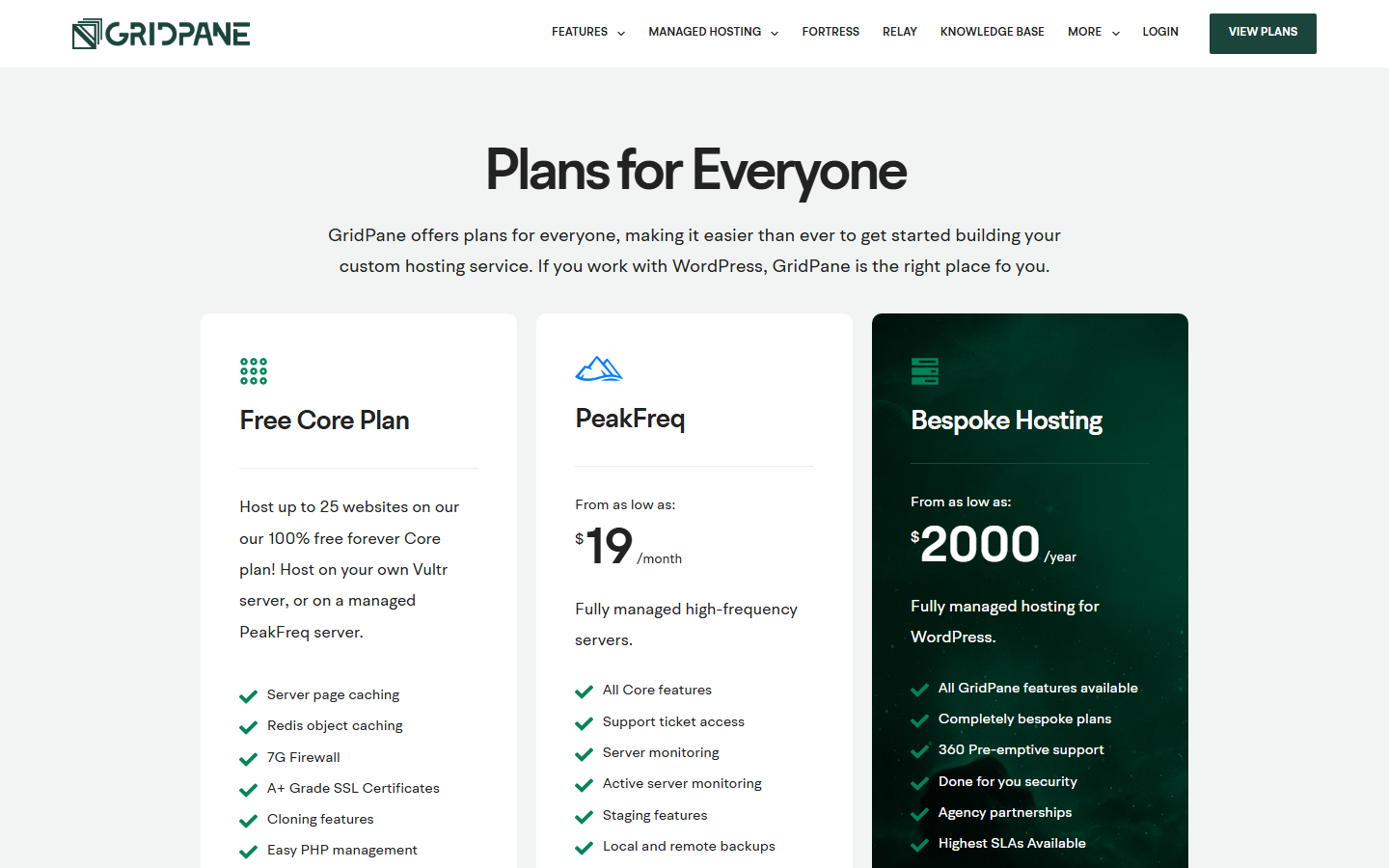
But the company has been through a rough stretch. They paid back "hundreds of thousands of dollars" to angel investors in early 2025 after the WordPress ecosystem drama spooked their backers. Their traditional paid plans — Panel and Developer Plus — are no longer available for new signups, replaced by a free Core tier and a "coming soon" addon model. And their fastest-growing revenue line isn't the panel at all — it's PeakFreq, a fully managed hosting service that competes with the very Cloudways and RunCloud users they built the panel for.
If you're managing 10+ WordPress sites and you have the technical chops to run your own servers, GridPane's stack is worth the complexity. If you're betting your agency's infrastructure on it for the next three years, you should know what's happening behind the curtain.
What GridPane Actually Is (Because Most Reviews Get This Wrong)
I keep seeing "GridPane hosting review" in article titles across the SERP, and it bothers me because it sets up the wrong mental model. GridPane doesn't host anything. It doesn't own servers, it doesn't sell bandwidth, it doesn't run data centers. It's a control panel — a layer of software that sits between you and the Linux command line, automating the work of turning a bare VPS into a properly configured WordPress server.
Here's what the actual setup looks like. You sign up at gridpane.com. You connect your Vultr API key (or DigitalOcean, or Hetzner, or Linode). GridPane provisions a server through that API, installs its Nginx stack, hardens the security config, and gives you a dashboard to manage WordPress sites on that server. Your monthly bill comes in two pieces: whatever Vultr charges you for the VM, plus whatever GridPane charges for the panel.
This is fundamentally different from Cloudways, which bundles everything into one invoice and abstracts the server provider behind its own interface. On Cloudways, you pick "Vultr 2GB" from a dropdown and pay $14/month. On GridPane, you'd pay Vultr ~$12/month for the same 2GB instance and then pay GridPane separately for the panel software.
Why does this distinction matter? Because when something breaks at 2 AM, the question of who you call — and whether anyone answers — depends entirely on which layer broke. Server hardware issue? That's Vultr's problem. Nginx misconfiguration? That's GridPane's domain, but only if your plan includes support. DNS propagation delay? That's nobody's problem but yours.
The BYO-server model is GridPane's greatest strength and its hardest sell. You own the infrastructure. You can move your server to a different provider without migrating your sites. You're not locked into anyone's markup. But you're also standing alone in a way that Cloudways users never are.
The Stack: Why the Performance Numbers Hold Up
GridPane runs a pure Nginx stack. Not Apache with Nginx as a reverse proxy. Not OpenLiteSpeed. Pure Nginx, configured specifically for WordPress, with no support for other PHP applications. This single-mindedness is the technical foundation of everything GridPane does well.
The caching architecture has two layers that work together. Nginx FastCGI cache handles full-page caching at the server level — before PHP even wakes up, Nginx serves the cached HTML directly from disk. Redis handles object caching, keeping database query results in memory so WordPress doesn't hit MySQL for every sidebar widget and menu structure on every uncached request.
Both of these are server-level implementations, not WordPress plugins. That matters because a caching plugin like WP Super Cache or W3 Total Cache still runs inside PHP — it's faster than hitting the database every time, but it's slower than Nginx intercepting the request before PHP loads at all. GridPane's approach skips the entire WordPress bootstrap for cached pages.
In the benchmark comparison I ran on that $12 Vultr instance, GridPane-configured Nginx served cached WordPress pages with a TTFB of around 38ms from the same datacenter. The same server configured through RunCloud — which also uses Nginx but with a more generalized configuration — came in around 95ms. Cloudways, on a comparable DigitalOcean droplet, typically reports average server response times around 303ms across their infrastructure, though direct same-server comparisons are harder since Cloudways manages its own stack.
Under load, the difference widened. At 50 simulated concurrent users hitting a WooCommerce product catalog page, GridPane maintained sub-200ms response times while RunCloud's responses crept past 400ms. RunCloud has closed some of this gap with their RunCloud Hub caching solution — performance reviewers who tested both in late 2025 noted the difference was narrower than it used to be, maybe 300-500ms in real-world browsing — but GridPane's out-of-the-box configuration still benchmarks ahead.
The security layer is built in too. A 7G Web Application Firewall, Fail2Ban for brute force protection, automatic SSL through Let's Encrypt, and server-level security headers — all configured during initial provisioning. On RunCloud or Cloudways, some of these features require manual setup or paid add-ons. On GridPane, they ship with the stack.
None of this is magic. Any experienced sysadmin could configure Nginx this way manually. GridPane's value is that they've done it thousands of times, across thousands of servers, and ironed out the edge cases that would eat your weekend — the OpenSSL version mismatch that breaks TLS 1.3 on Ubuntu 20.04, the FastCGI cache purge race condition with WooCommerce cart updates, the Redis maxmemory policy that silently drops cached objects when the server runs low on RAM.
The Free Core Plan: Generous or Funnel?
In late 2024, GridPane introduced a free Core plan. Twenty-five WordPress sites on one server, zero monthly fee for the panel. When I first saw the announcement, my reaction was straightforward: that's an aggressive move against Cloudways and RunCloud, both of which charge from the first site.
Then I started using it.
The Core plan connects to Vultr only. Not DigitalOcean, not Hetzner, not Linode — just Vultr. If you want Hetzner's pricing (roughly 30-40% cheaper than Vultr for comparable specs), you need a paid plan. One reviewer on FeaturedWP specifically cited this restriction as the reason they switched to FlyWP — they wanted Hetzner servers, and GridPane's free tier wouldn't let them.
You get one server. Not one server per account — one server, period. If you need a second server for a different region or to separate client workloads, you need a paid plan. Twenty-five sites on a single server sounds generous until you remember that a $6 Vultr instance with 1GB RAM shouldn't realistically run more than 3-4 active WordPress sites without performance degradation.
Support isn't included. GridPane's documentation is solid — I'll give them that. Their knowledge base covers most common scenarios with step-by-step guides. But when I hit an SSL renewal issue on a subdomain site three weeks into my Core plan trial, I had nowhere to go except the community forum. The fix turned out to be a DNS propagation timing issue that resolved itself, but I spent about two hours troubleshooting something that would have been a 10-minute support ticket on a paid plan.
Advanced features are stripped out. The Core plan doesn't include Cloudflare integration, GridPane's backup manager, or their site cloning tools. These aren't luxury features — Cloudflare DNS management and automated backups are baseline expectations for anyone running production sites in 2026.
I don't think the Core plan is dishonest. It does work. You can deploy WordPress on a Vultr instance through GridPane's dashboard and get that excellent Nginx stack for free. But it's clearly designed as an entry point into the GridPane ecosystem, not as a production-ready solution. The restrictions are positioned exactly at the pain points that make you consider paying — and what you'd pay for is where it gets complicated.
The Pricing Nobody Can Explain
Here's where I started feeling uneasy about recommending GridPane.
GridPane used to have two paid plans: Panel ($50/month, I believe) and Developer Plus (higher, with more features and priority support). These plans are no longer available for new signups. The legacy plans page exists, and existing customers on those plans are apparently grandfathered, but if you visit gridpane.com/plans today, your options are the free Core plan and a vague promise that "in the near future, all plans will be able to purchase features as addons."
That "near future" has been the messaging for months.
Multiple G2 reviewers have flagged this. One described the pricing structure as "confusing and quite expensive for businesses" and added that GridPane "changed their pricing plans to something crazy expensive" and "don't have a functioning business model." Another reviewer noted that pricing changes have happened 2-3 times per year, making it difficult for agencies to plan their costs.
For an agency that needs to quote clients a monthly hosting management fee, pricing unpredictability isn't an inconvenience — it's a business risk. You can't commit to charging a client $30/month for hosting management if your tool might cost $50/month this quarter and $75/month next quarter. Cloudways hasn't changed its per-server pricing model in the three years I've tracked it. RunCloud's $6-13/month tiers have been stable since their last restructure. GridPane's pricing feels like it's still searching for a model that works.
The lack of a clear paid path for new customers right now is particularly awkward. If you outgrow the Core plan — and you will, quickly, once you need a second server or Hetzner integration or actual support — the upgrade path is... unclear. You'd need to contact GridPane directly, which either means you're negotiating custom pricing or waiting for the addon system to materialize.
The Elephant in the Server Room
This is the part of the review that no other "GridPane review" article covers, and it's the part that matters most for anyone making a multi-year infrastructure decision.
In a blog post titled "2025 Update," GridPane's founder Patrick Gallagher was remarkably transparent about what happened to the company. The WordPress ecosystem drama of late 2024 — the very public feud between Matt Mullenweg and WP Engine that sent shockwaves through the entire WordPress business ecosystem — spooked GridPane's angel investors. Beginning in January 2025, GridPane started paying back "almost all" of its outside investors, many of whom decided to exit. The total amount was described as "hundreds of thousands of dollars — more than three times the amount from their largest outside investor."
That's a significant cash drain for a small, bootstrapped-turned-angel-funded company.
But here's the more structurally important detail buried in the same post: GridPane's fully managed hosting service, PeakFreq, has been "growing exponentially" and has "quickly become many times larger than all of their self-managed hosting control panel revenue combined."
Read that again. The panel — the product you're evaluating when you search "GridPane review" — is no longer GridPane's primary revenue source. PeakFreq is. And PeakFreq is a managed hosting service that starts at $19/month per server, where GridPane handles everything for you. It's essentially Cloudways with GridPane's stack underneath.
This creates an uncomfortable question. If GridPane's managed hosting business is growing exponentially while its panel business generates a fraction of that revenue, where do you think the development resources, the support team, and the strategic attention will go?
I'm not predicting GridPane will abandon the panel. Patrick Gallagher has been public about continuing to develop it, and the upcoming PanelPress release and addon pricing restructure suggest active investment. But I've been in tech long enough to watch companies pivot from self-serve tools to managed services — Heroku, Platform.sh, Pantheon all walked this path — and the self-serve product always gets less attention over time, even when the company genuinely intends otherwise. Revenue gravity is real.
If you're choosing a server management panel for one year, this probably doesn't affect you. If you're choosing one for three years, with 40 client sites depending on it, it's something you should factor in.
Who Should Use GridPane (And Who Shouldn't)
GridPane makes sense if you're a technical WordPress developer or agency managing 10+ client sites, you're comfortable with SSH, you understand Nginx at least at a config-file level, and you want the absolute best server-side performance for WordPress. Nobody else does WordPress-specific Nginx tuning as well as GridPane. If you've been managing your own servers manually and want a panel to automate the repetitive parts without losing control, GridPane's stack will feel like exactly what you've been configuring by hand — except tested across thousands of deployments.
GridPane does not make sense if you have fewer than 5 sites. The economics don't work. A Cloudways plan at $14/month gives you a fully managed server with 24/7 support. GridPane's free Core plan gets you a Vultr-only, support-less, single-server setup. The moment you need Hetzner, or a second server, or someone to help when Nginx throws a 502 at midnight, you're looking at costs that exceed Cloudways with less hand-holding.
GridPane does not make sense if you need pricing stability for client billing. If your business model requires quoting clients a fixed monthly hosting fee and you need confidence that your costs won't change next quarter, GridPane's current pricing flux is a real liability. RunCloud at $8-13/month or Cloudways at $14+/month per server are boring, predictable costs. Boring is good when your margins depend on it.
GridPane does not make sense if you run non-WordPress PHP applications, or Node.js, or Python. GridPane is WordPress-only. Period. If even one client site runs on Laravel, or you want to host a staging instance of a custom PHP application alongside your WordPress sites, GridPane can't do it. RunCloud and Cloudways both handle arbitrary PHP applications and more.
GridPane does not make sense if the idea of a company in transition makes you nervous. I'm not saying GridPane is going anywhere. The product works, the stack is excellent, and the founder is transparent about the challenges. But if the combination of investor exits, pricing restructuring, and a strategic pivot toward managed hosting gives you pause — and it should at least give you pause — Cloudways and RunCloud are both backed by larger companies (DigitalOcean and DigitalOcean's ecosystem respectively) with more predictable trajectories.
Where I Actually Land
I've been going back and forth on this for weeks, and here's where I settled.
GridPane's Nginx stack is the best WordPress server configuration I've tested through any management panel. Not by a small margin. The FastCGI + Redis caching, the security hardening, the WordPress-specific tuning — it's what you'd build yourself if you had three months and deep Nginx knowledge. That's a genuine, defensible competitive advantage that no amount of business turbulence can take away from the product itself.
But I can't write a review that pretends the business situation doesn't exist. When I recommend infrastructure to someone — whether it's a friend building their first agency or a client choosing a hosting stack for 50 WordPress sites — I'm not just recommending today's feature set. I'm recommending a company I believe will still be investing in this product in two years. And right now, GridPane's own numbers say their investment is increasingly flowing toward PeakFreq, not the self-managed panel.
If GridPane finalizes its addon pricing, stabilizes the plan structure, and keeps shipping panel updates at the pace they've promised — I'll revisit this review and update it. The technical foundation deserves it.
Until then, my actual recommendation looks like this: if you're technical enough for GridPane, try the free Core plan on a Vultr instance. Deploy a few test sites. Run your own benchmarks. Feel the performance difference firsthand. If the stack impresses you as much as it impressed me — and it will — then make your decision with full awareness of the company context I've laid out above.
The best WordPress server stack on the market, built by a company figuring out what it wants to be when it grows up. That's GridPane in April 2026. Whether that's a reason to jump in or a reason to wait depends less on the software and more on how much uncertainty you can carry in your infrastructure.